
As reported by Dylan Campbell, much has changed in Down Under over the past few years. For a long time, automotive manufacturing in Australia was considered a closed chapter. After the end of Holden, it seemed inevitable that large-scale vehicle production had disappeared for good. That assumption, however, does not survive a visit to Melbourne’s south-eastern industrial suburb of Dandenong.
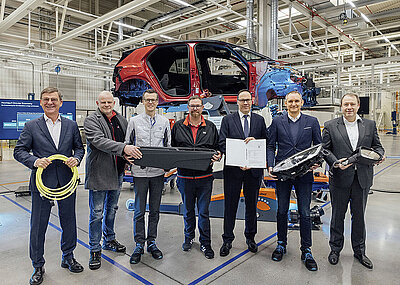
Tucked away on an unassuming side street, a vast industrial complex rises into view. What stands here today would have been almost unthinkable in 2018: Australia’s newest automotive manufacturing facility. Opened in November 2025, the site is now the beating heart of the Walkinshaw Automotive Group, formerly known as Holden Special Vehicles.
Under a single roof spanning 53,000 square metres, Chevrolet Silverados and Dodge Ram pick-ups are converted from left-hand to right-hand drive for the Australian market. Production of the Volkswagen Amarok W600 is set to begin shortly, while the facility also houses design, engineering and race preparation for the Toyota GR Supra factory Supercars programme run by Walkinshaw Andretti United. In addition, Walkinshaw manages right-hand-drive conversion programmes for the Toyota Tundra and GMC Yukon. Altogether, more than 13,000 vehicles now pass through the company’s hands each year — a volume that would have seemed unrealistic only a few years ago.
The path to this point was far from straightforward. When Holden closed its South Australian plant in October 2017 and the final HSV Commodore rolled off the line later that year, the story appeared to be over. Thirty years of production and more than 90,000 vehicles came to an end. Yet while the Commodore disappeared, something crucial remained: a highly skilled workforce of engineers, designers and manufacturing specialists, along with deep expertise in low-volume vehicle production.
In the years that followed, Walkinshaw broadened its engineering and manufacturing services for global automotive partners. Growth came quickly, but not always efficiently. At one stage, operations were spread across seven different sites in Melbourne’s south-east, creating logistical complexity and rising costs. The decision was eventually made to consolidate all capabilities at a single, purpose-built location.
Construction of the new facility began in June 2020, with the official opening taking place on 17 November 2025. Today, around 600 employees work on site during the day, with a further 300 joining during the evening shift. At full capacity, the site has the infrastructure to accommodate up to 1,500 staff.
The scale and capability of the factory are striking. Built on a 120,000-square-metre plot, it contains five production lines across 25,000 square metres, a 7,000-square-metre engineering and design department, and a 12,000-square-metre warehouse capable of holding more than 12,500 pallets. In the reception area, two of the final and most desirable HSV Commodores — including the iconic GTSR W1 — serve as reminders of the past, set against a backdrop that clearly points to the future.
Efficiency has been a guiding principle throughout the facility’s design. Instead of curved or U-shaped production lines, the factory features straight, 110-metre assembly lines that simplify logistics and material flow. The site also includes an electrical laboratory, HVAC testing facilities, 3D printing for rapid prototyping, structural testing, environmental and vibration chambers, a photometric laboratory and an engine test cell. It is ADR-certified and designed to be hydrogen-ready. In essence, everything required to design, engineer, test and build a vehicle from the ground up exists within one location.
With this level of technical capability, the question naturally arises as to whether Walkinshaw could one day build its own vehicle. The idea of a low-volume Australian supercar has been discussed internally, not as a mass-production ambition but as a concept that would showcase the company’s full range of expertise. While current workloads leave little room for such a project in the short term, the idea remains firmly on the table.
Despite this success, a return to large-scale mass automotive manufacturing in Australia remains unlikely. The industrial supply chain that once supported high-volume production has largely disappeared. With the withdrawal of major OEMs, stamping plants, large-scale moulding operations and tooling infrastructure vanished as well. Rebuilding such an ecosystem would require the creation of an entire industry from scratch.
What Walkinshaw demonstrates, however, is that the Australian automotive industry is far from dead. It has evolved, adapted and reinvented itself. And sometimes, a total turnaround begins precisely where few are still looking.