After a transitional phase that began on 1 October 2023, during which no taxes were levied on imported goods but only data on the quantity of imported products was collected and the companies concerned were approved, the CBAM will come into full effect on 1 January 2026. From that date, a levy will be imposed on certain imported carbon-intensive goods, such as aluminium, based on the emissions they contain, similar to the levy that European companies have to pay under the EU Emissions Trading System (EU ETS).
Objectives and limitations of the CBAM
As a pillar of the Green Deal and an integral part of the ‘Fit for 55’ package, the CBAM was created with the aim of significantly reducing greenhouse gas emissions: by 55% by 2030 compared to 1990 levels, in order to achieve climate neutrality by 2050. The new environmental tax is also intended to ensure fair competition between European manufacturers and players outside the EU. As innovative as this instrument is, it does have some limitations, both operational and economic.
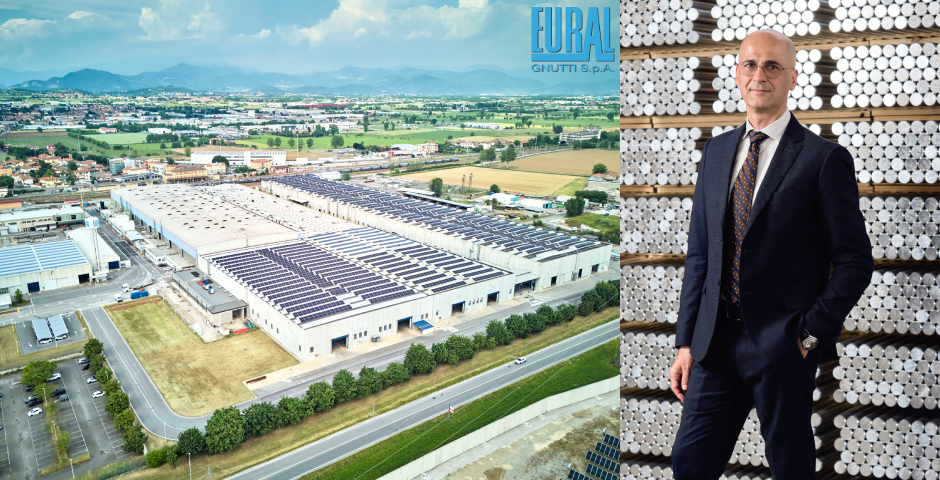
We discuss this with Giorgio Di Betta, Sales Director at Eural Gnutti, President of CentroAl and the Extrusion Division at the European Aluminium Association.
Recently, several MEPs submitted a question to the Commission regarding the impact that the CBAM mechanism could have on the aluminium industry in the Union. The limitations include loss of competitiveness, market distortions and risks to industrial sovereignty. Can you explain the situation in more detail?
Despite the aim of rebalancing competition between European and non-EU manufacturers and preventing carbon leakage, i.e. the relocation of CO2 emissions, the CBAM has numerous limitations. One of the biggest weaknesses is the risk of so-called ‘resource shuffling’, i.e. the possibility for manufacturers outside the EU to supply only the ‘cleanest’ quantities from low-emission sources to Europe and to divert the more environmentally harmful products to other, less regulated markets. This practice distorts competition, as exporters outside the EU only have to self-certify their emission values without being able to prove their actual reliability. There is a high risk of ‘greenwashing of data’, as the values reported may not reflect actual emissions. Furthermore, the CBAM may represent a double disadvantage for European manufacturers, who are already subject to a carbon dioxide emissions compensation system that requires them to purchase the corresponding amount of ETS certificates, regardless of the degree of decarbonisation already achieved in their production processes.
Is the CBAM mechanism being applied fairly in its current form?
Currently, the CBAM is not being applied fairly, as it does not take into account a wide range of processed products containing aluminium, such as wheels, cans, packaging, automotive components or architectural elements. The exclusion of these downstream items leads to significant distortions of competition along the supply chain, as manufacturers of semi-finished or finished products outside the EU can continue to export to Europe without incurring the corresponding costs, which significantly increases the risk of carbon leakage. Furthermore, the mechanism does not affect competing materials such as copper, plastic and brass, whose production and processing are equally energy-intensive and environmentally harmful.
Is the CBAM mechanism really an incentive for aluminium recycling, as envisaged in the Green Deal?
Although aluminium recycling makes strategic sense and is compatible with the Green Deal, it is currently disadvantaged because there is no specific reference value for it in the ETS. The reference parameters are general and based on data on heat and fuel consumption from very different and less energy-intensive sectors. The latter include the use of alternative sources such as biomass to supply the plants. This solution is not technically applicable to aluminium recycling, as it requires high temperatures. Essentially, this approach does not favour aluminium recyclers.
What measures could be implemented?
With regard to the problem of ‘resource shuffling’, it would make sense to apply a predefined standard carbon value, which would be set by individual countries on the basis of already known values and for all aluminium products, and would be based exclusively on the CO2 values of the primary aluminium of the respective country. In addition, it would be useful to consider introducing a specific ETS benchmark for aluminium recycling, which would allow for a fairer allocation of quotas in proportion to production efficiency. These measures could serve as a deterrent to unfair competition and truly reward efforts to decarbonise the European aluminium chain.
How is the European Union proceeding?
In general, we note that the European Union is working towards simplifying the CBAM mechanism and introducing a system to monitor the import and export of scrap in order to address the issue of scrap leakage. As Maroš Šefčovič (EU Commissioner for Trade and Economic Security) announced on 18 November at the European Aluminium Summit 2025, the European institutions have recently expressed their intention not to completely block the export of aluminium scrap, but to define balanced measures to ensure access to adequate quantities of this strategically important material at competitive prices. This is a plus for all players in the aluminium chain, who can thus continue on the path to decarbonisation, in line with the principle of the circular economy. One innovation concerns the CBAM reference value for aluminium recycling. The Commission recently confirmed (in November 2025) that, following the revision of the ETS parameters in 2026, a reference value will be available that reflects the ‘typical production processes’ for each CBAM product group, including aluminium.
Eural Gnutti – www.eural.com
Eural Gnutti was founded in Rovato in 1968 and specialises in the production of semi-finished aluminium alloy products. The company is a world leader in the production of drawn rods and is one of the largest European manufacturers of extruded rods and profiles. The company's rods are particularly valued in the mechanical engineering, automotive, aerospace, medical, electrical, electronics and defence industries, while its profiles, which are characterised by special heat treatments, are intended for the automotive, pneumatic, drive and hydraulic sectors, as well as for companies that manufacture heat sinks. With a total area of 355,000 m² (of which 70,000 m²is covered), spread across the two production sites in Pontevico and Rovato, Eural Gnutti employs 404 people and achieved a turnover of €244 million in 2024, which is growing steadily thanks to strategic branches in America and Germany through the wholly-owned subsidiaries Eural USA Inc. and Eural Deutschland GmbH.
Source: www.lbdi.it