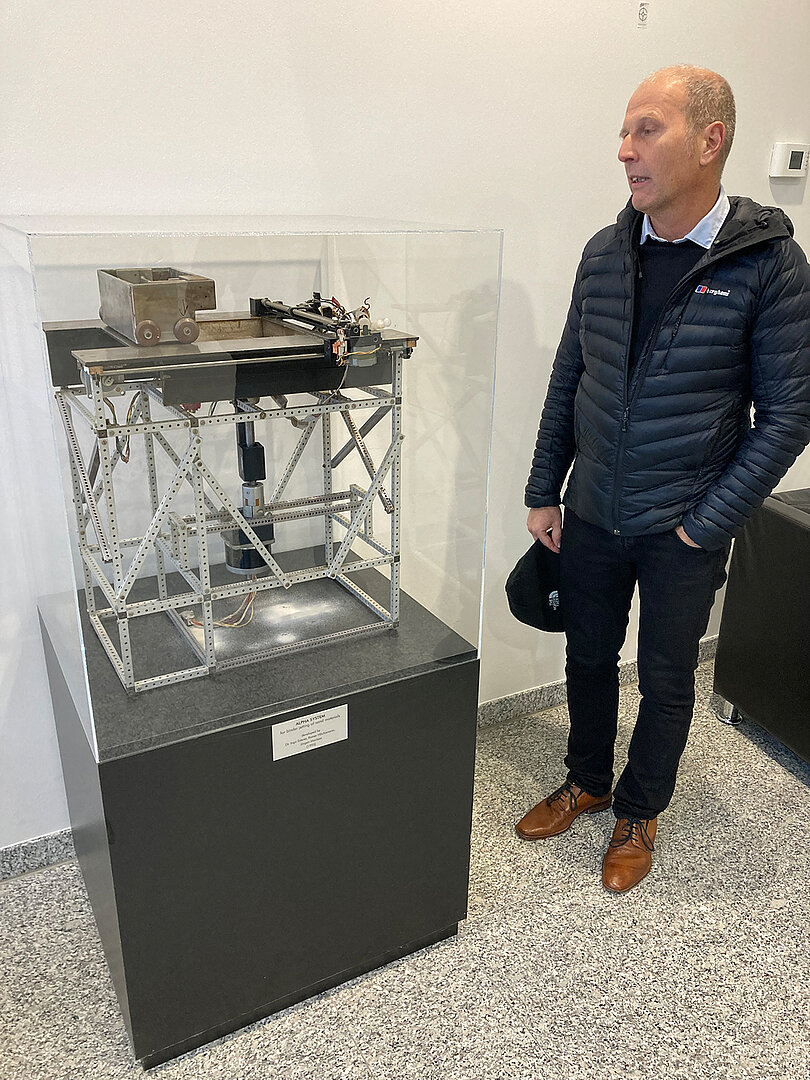
“Sand was the game changer,” explains Ederer. “Once we realized that binder jetting could process sand faster, more economically, and at larger scales than alternative technologies, the path toward industrialization became obvious.”
From the outset, the focus was on a foundry-ready overall solution: suitable binder chemistry, high process stability, and scalability to large build volumes. How visionary this approach was became evident around the year 2000, when a consulting firm’s initial market assessment estimated global demand at just eleven systems—reflecting the skepticism that surrounded a technology far ahead of its time.
“We were often told that the market simply didn’t exist,” says Rudolf Franz. “But we believed that if the technology truly solved industrial problems, the market would follow—and history has proven that assumption right.”
The early years were marked by considerable technical challenges. Different approaches to sand recoating proved unstable or difficult to control, while aggressive chemical components placed high demands on materials and machine design. Only through continuous material exchange and development of new recoating and advanced printhead technologies the breakthrough to a stable, reproducible process occured. “There were moments when success was far from guaranteed,” Franz admits. “The technology stood on the brink of failure more than once. What ultimately made the difference was persistence—and the willingness to rethink fundamental process steps.”
The breakthrough
In 2003, patent-related issues led to the split of the original company called Generis into two strategic paths: voxeljet initially focused on on-demand printing services and later large-format systems, while ProMetal—later ExOne—pursued the systematic expansion of the international system business. Both approaches played a decisive role in the industrialization of 3D sand printing.
“Looking back, the split was not a setback but an acceleration,” says Ederer. “Two different strategies addressed different market needs, and together they pushed binder jetting much faster into industrial reality.”
Foundry requirements, particularly from the automotive industry, acted as a key innovation driver. Parameters such as build volume, printing speed, surface quality, system robustness, and material selection were continuously refined in close collaboration with users. A milestone was the first sale of systems to BMW and Daimler in 2002, followed by the technological breakthrough with larger installations in the United States from 2004 onward.
“What convinced customers was not a single feature, but the overall reliability of the process,” notes Franz. “Once automotive OEMs trusted the technology, adoption accelerated rapidly.”
By the mid-2010s, printed sand had become the standard technology for prototypes and small series, with multi-system installations and serial production of complex geometries emerging from around 2020.
The core of the process
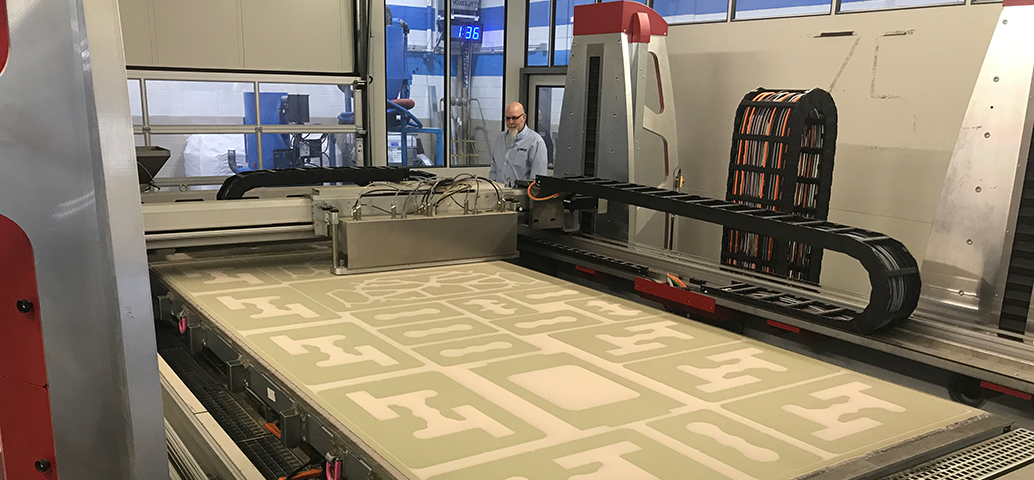
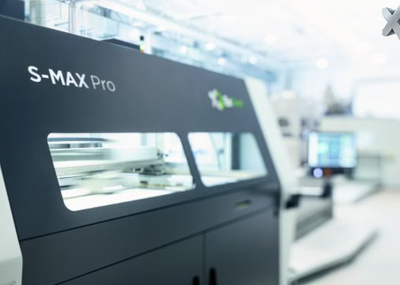
The heart of binder jetting—the printhead—has undergone a major technological leap in recent years. Productivity has been multiplied, service life increased from just a few hours to around 4,000 operating hours, and process stability significantly improved. Milestones such as the S15 sand printer, PMMA printing, installed SMAX machine fleets, large-format systems like the VX4000, and recent advances in automation and productivity form the basis for numerous industrial applications.
“Today, many applications in automotive manufacturing, aerospace, wind energy, or the field of gigacastings would simply not be feasible without 3D sand printing,” emphasizes Whitney Haring-Smith. “What once started as an experiment has become a backbone technology of modern foundries.”
New momentum is being generated by large-format printers, software-based surface optimization, and further scaling. At the same time, CAD design, design for additive manufacturing, and the structural transformation of the foundry industry remain key challenges—making specialization and technological expertise increasingly important.
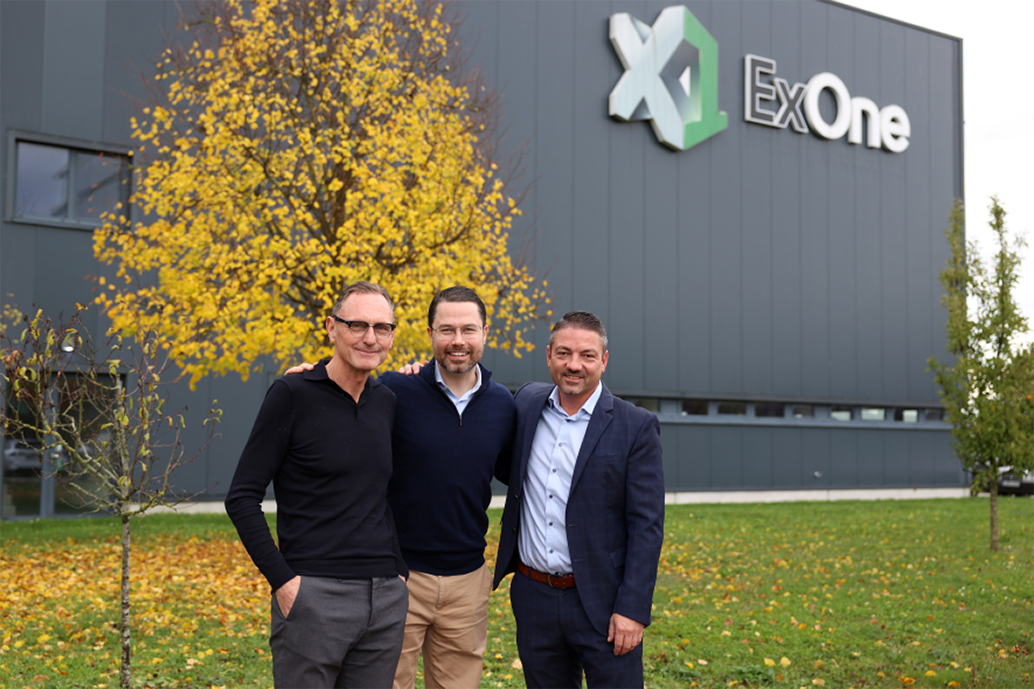
Today, ExOne and voxeljet are once again combining their complementary strengths. With more than 500 systems installed worldwide, a strong service organization, and consolidated development resources, a globally positioned network for additive manufacturing is taking shape.
“Our customers and partners will benefit from stability and continuity going forward,” says Eric Bader, CEO of ExOne Global Holdings. “By bringing together ExOne’s leadership in digital sand casting with voxeljet’s expertise in large-format industrial 3D printing, we are pooling decades of experience. Our goal is to ensure reliability, drive innovation in a focused way, and enable sustainable growth.”
The merger thus represents not only a strategic step, but also a consistent next chapter in the history of additive manufacturing—from its experimental beginnings to a key industrial technology for the foundry industry.