When tolerances become a system issue, pure parts manufacturing is no longer sufficient — integrated process expertise is required. This is precisely where Ningbo Mingxin Electrical Machinery Manufacturing Co., Ltd. positions itself.
The company is located in the Beilun Automotive Industrial Park in Ningbo, directly adjacent to the port — one of China’s most important logistics hubs — and operates more than 14,000 m² of floor space and over 20,000 m² of production facilities.
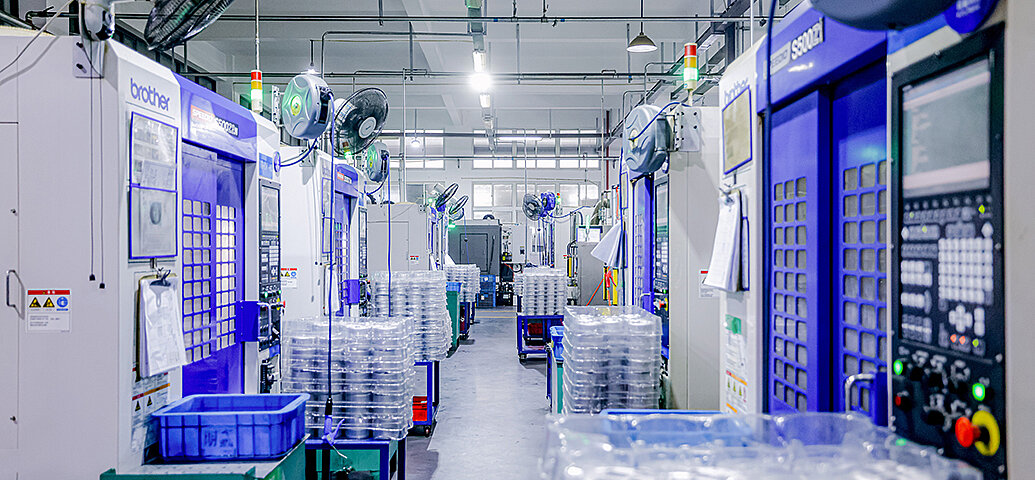
Founded in 2003 with a focus on mould making, Mingxin has evolved over two decades into a comprehensive manufacturing partner. Today, the company combines tool design and construction, aluminium and zinc die casting, CNC precision machining, and surface treatment under one roof. These capabilities are supported by an experienced technical and management team, as well as certified quality and environmental management systems in accordance with IATF 16949 and ISO 14001.
Process integration as a competitive factor
In the European market for high-quality die-cast components, process integration — rather than isolated individual services — is increasingly becoming the decisive competitive advantage.
As tolerances tighten and component complexity increases, manufacturers must deliver reproducible quality even at high volumes.
Particularly in industries such as automotive electronics, security technology, robotics, and nuclear applications, aluminium die-cast parts must withstand long-term thermal, mechanical, and environmental stresses.
Limits of fragmented manufacturing
Traditional supply chains separate toolmaking, casting, machining, and surface treatment. While this may be sufficient for simple components, it becomes risky for parts requiring tolerances below ±0.05 mm or function-critical surfaces.
Interface losses, correction loops, and quality variations lead to higher costs and longer lead times.
Closed manufacturing systems that combine all steps within a unified engineering and quality framework are therefore becoming increasingly important.
Why closed processes work
In integrated structures, decisions made during tool design and simulation directly influence subsequent machining accuracy and surface quality. Close coordination reduces losses and enables early error detection.
The result:
- faster process stabilisation
- higher yield
- lower quality costs
- better scalability for large series
Early involvement reduces risks
European OEMs and Tier suppliers are increasingly involving die-casting partners during the production-ready design phase.
Together, they optimise:
- wall thicknesses
- flow behaviour
- gating and venting concepts
- tolerance chains
- material and coating requirements
This early coordination prevents late design changes and ensures long-term production stability.
Surfaces as a function — not cosmetics
Today, surface treatments are technical performance features rather than purely visual elements:
- corrosion protection and tightness for safety components
- wear resistance for robotics and automation
- low-reflection, uniform finishes for optical systems
When coating processes are integrated directly into production, parameters can be precisely tailored to casting and machining — instead of compensating for deviations afterward.
Cross-industry requirements
Despite differing applications, similar principles apply:
- Safety components → porosity control and tightness
- Nuclear components → dimensional stability under extreme conditions
- Automotive electronics → lightweight construction, heat dissipation, minimal distortion
Consistent performance is achieved less through isolated steps and more through disciplined, cross-process control.
Conclusion
As technical requirements continue to increase, integrated engineering is replacing isolated process know-how.
Companies that combine engineering, manufacturing, and quality systems are evolving from simple suppliers into long-term development partners — a decisive success factor in European precision die casting.
MingXin Machinery
Three decades of die-casting expertise for the European market
Since 1992, MingXin High Precision has focused on high-pressure die casting and has steadily evolved from a parts supplier into an engineering partner.
The goal is not only to deliver components, but to provide holistic solutions to technical challenges.
The company offers a continuous process chain consisting of:
- tool development
- die casting
- CNC machining
- surface finishing
Simulations with MAGMA, robot-assisted machining, and automated painting lines ensure reproducible quality from raw material to finished product. Customers benefit from lower scrap rates, more stable processes, and improved cost control.
Production capacity
- 18 die-casting machines (100–800 t)
- over 150 CNC centres
- around 500 employees
- up to 70,000 parts per day
- 99.5% on-time delivery
Certifications according to ISO 9001, IATF 16949, and ISO 14001 underline the company’s commitment to quality. Its solutions are used in automotive engineering, safety systems, robotics, and demanding industrial and energy applications.
With its combination of long-standing experience and digitalised manufacturing, MingXin exemplifies the shift toward intelligently integrated production — positioning itself as a long-term partner for European customers.
Contact
mingxin@nb-mxdq.com
www.nbmxdq.com