Partner

Power supply of channel inductors with IGBT converters

A field report based on practical experience

Lesedauer: min | Bildquelle: Induga

by Christian Reul, Sebastian Esser, Frank Donsbach

1. GENERAL

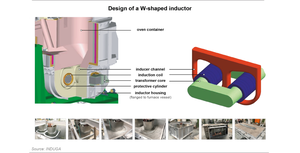
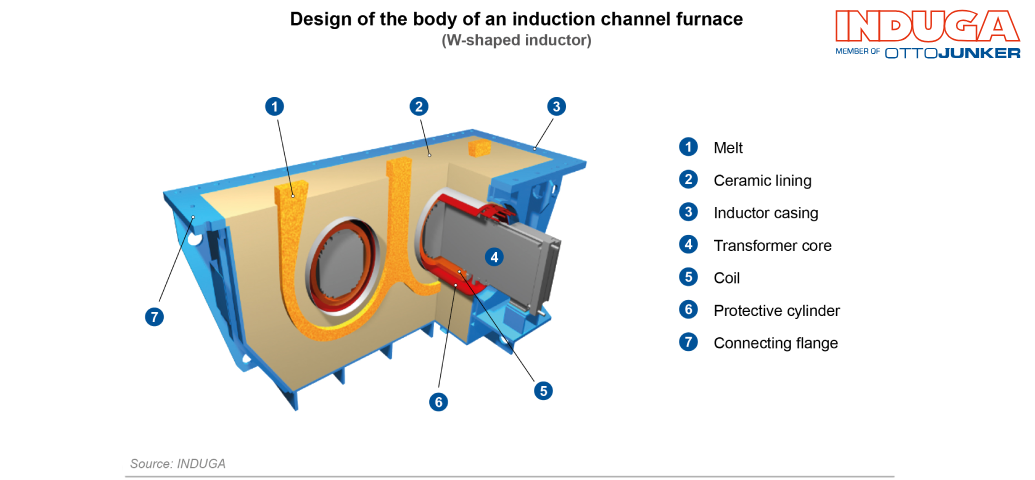
The channel furnace works to the same principle as a transformer with a channel of liquid metal representing the secondary (short-circuited) winding of the transformer. The short-circuit current causes ohmic losses and heats up the liquid metal, thus transferring heat to the furnace vessel which can have any shape under moderate bath movement.

Depending on the application, the furnace vessel can have the shape of a trough, a drum or a cylinder. Pressurized multi-chamber furnaces can also be designed that way. The primary winding is connected to a power supply which provides a suitable voltage (in practice, usually between 180 and 690 V) and compensates the inductive reactive power of the inductor. 

Except for a few special applications, the channel furnace (contrary the coreless furnace) should not be emptied completely and always has to be filled with liquid melt. It is therefore ideally suited for continuous melting and pouring processes without frequent alloy changes.

The high efficiency of the channel furnace has made it THE standard melting furnace, particularly for highly conductive materials such as copper. The energy consumption for melting copper and aluminium can be about 25 % lower as compared to a coreless furnace. 

Since the heat is generated in the channel, it is very important to transfer a sufficient amount of this heat to the furnace vessel which is why it is vital to achieve high flow speeds in the inductor.

Due to the electro-magnetic Lorentz forces [1], there is a formation of intensive vortices in the channel cross section. In addition to this flow, there is a transit flow caused by thermal buoyancy forces throughout the channel. The speeds achieved by this transit flow are considerably lower than those of the electro-magnetically generated vortices. As a consequence, there is a very complex flow behaviour which can be stabilized by an asymmetrical design of the channel legs. On average, the flow towards the opened-up channel leg (trumpet) [1] is almost guided. 

In order to achieve a particular holding power consumption or melting rate, the inductor must be sufficiently dimensioned. An excessive inductor power may cause overheating of the melt and, thus, of the ceramic lining. If the electro-magnetic forces become too high, there is the additional risk of the liquid metal being cut off. As a consequence, no current can get into the channel and the electric behaviour of the inductor changes very abruptly. This is called “pinching”. 

2. CHANNEL INDUCTORS

There are W-shaped and V-shaped inductors, i.e. single-loop and twin-loop inductors. Throughout this document, we usually refer to W-shaped inductors.

With the Scott inductor, different coils were connected to the W-shaped inductor, the basic coil and the elevation coil. The advantage with this arrangement was that there can be a three-phase connection of the inductor which only needed compensating. The disadvantage, however, was that the star point is not clearly defined causing network imbalances. In addition to that, the phase voltage is shifted by 90°. If the two coils have the same core (one inductor), this means that the field is not in phase and that the stray losses are high.

These days, the two coils of a channel inductor are identical and usually connected in parallel so that there can be a two-phase connection to the switchgear. A detailed description of the switchgear can be found in the next chapter.

With higher powers, the coils can be connected in series. However, if one loop of the twin-loop inductor gets clogged due to outside circumstances, the respective coil, contrary to the parallel connection, needs to be short-circuited in order to be able to continue operation of the inductor at half power. 

With the Scott inductor, different coils were connected to the W-shaped inductor, the basic coil and the elevation coil. The advantage with this arrangement was that there can be a three-phase connection of the inductor which only needed compensating. The disadvantage, however, was that the star point is not clearly defined causing network imbalances. In addition to that, the phase voltage is shifted by 90°. If the two coils have the same core (one inductor), this means that the field is not in phase and that the stray losses are high.

These days, the two coils of a channel inductor are identical and usually connected in parallel so that there can be a two-phase connection to the switchgear. A detailed description of the switchgear can be found in the next chapter.

With higher powers, the coils can be connected in series. However, if one loop of the twin-loop inductor gets clogged due to outside circumstances, the respective coil, contrary to the parallel connection, needs to be short-circuited in order to be able to continue operation of the inductor at half power. 

3. SWITCHGEAR UNIT

3.1 Steinmetz

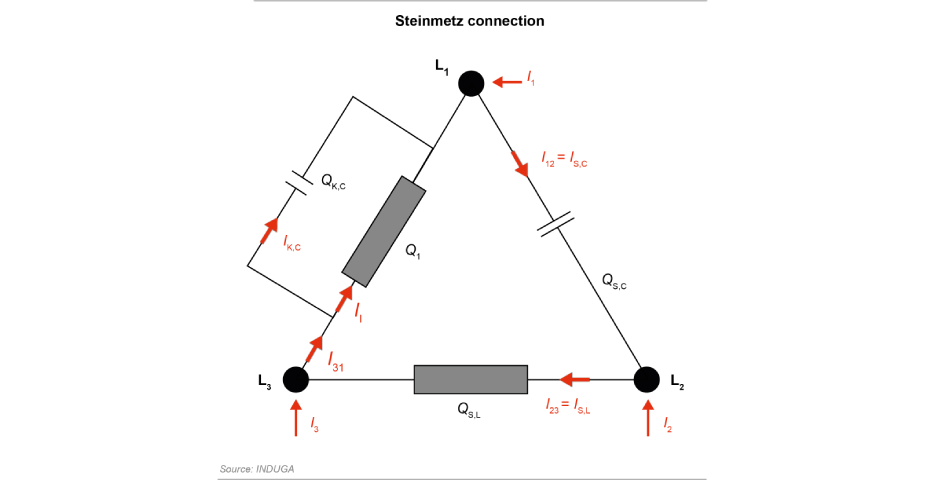
The Steinmetz connection is the switchgear commonly used for operating an inductor. It always consists of a phase balancing system which symmetrically distributes the two-phase load to the three-phase network and the power factor correction of the inductive inductor coil. 

3.2 V connection

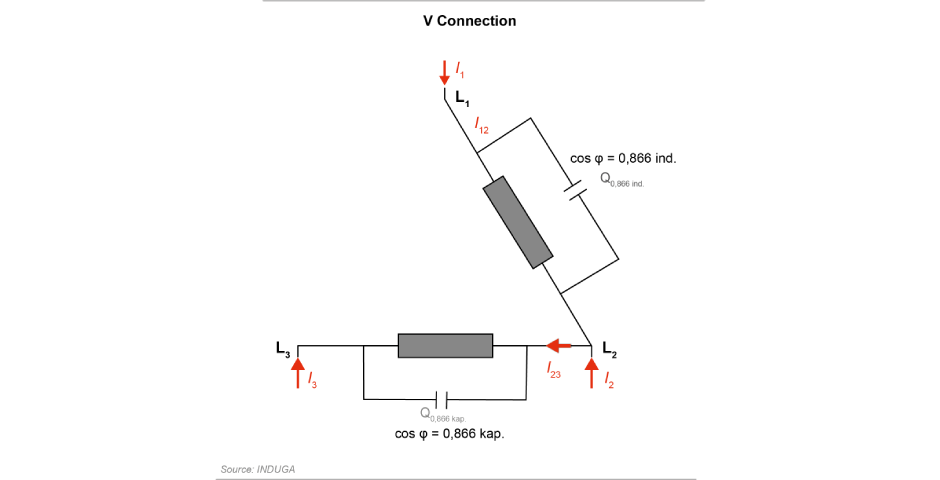
The V connection allows the simultaneous operation of two inductors. This type of connection is an economy connection in order not to have to run a separate switchgear for each inductor. One inductor is compensated to cos (phi) 0.866 ind. and the second inductor to cos (phi) 0.866 cap. 

With this arrangement, the two inductors are connected to the mains symmetrically. However, if one inductor fails, only two phases of the mains and of the switchgear transformer are loaded which is not permitted continuously. 

These days, this kind of switchgear is used for the operation of coating vessels with several inductors, for example.

Both types of switchgear are usually arranged in closed cubicles these days rather than in open racks. In addition to that, the trend is towards using enclosed power contactors in order to avoid the wear-intensive contacts of bar-mounted contactors. However, bar-mounted contactors offer the advantage of being able to transfer higher currents. 

These types of switchgear have almost gone completely out of fashion with coreless inductors. 

3.3 IGBT frequency converters

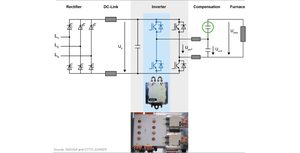
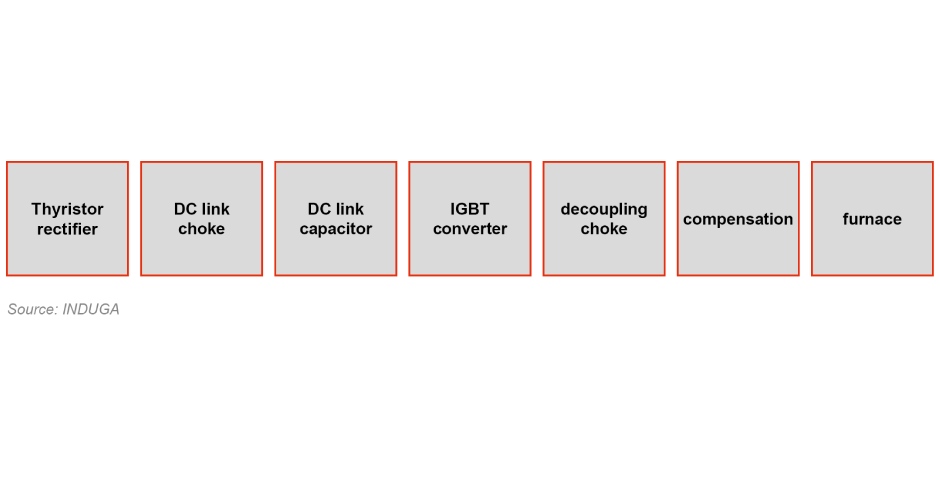
While channel inductors can still be supplied by the above switchgear units, coreless furnaces are almost exclusively supplied by frequency converters. However, frequency converters, particularly the IGBT converters described below, are getting increasingly popular for channel inductors as well. Induction furnaces basically are a two-phase load with a low cos (phi) of between 0.1 and 0.4. In order to rate the frequency converter for the real power of the furnace only, the inductive reactive power of the furnace needs to be compensated by means of a suitable number of capacitors. Basically, there are two ways of doing this: serial compensation and parallel compensation.

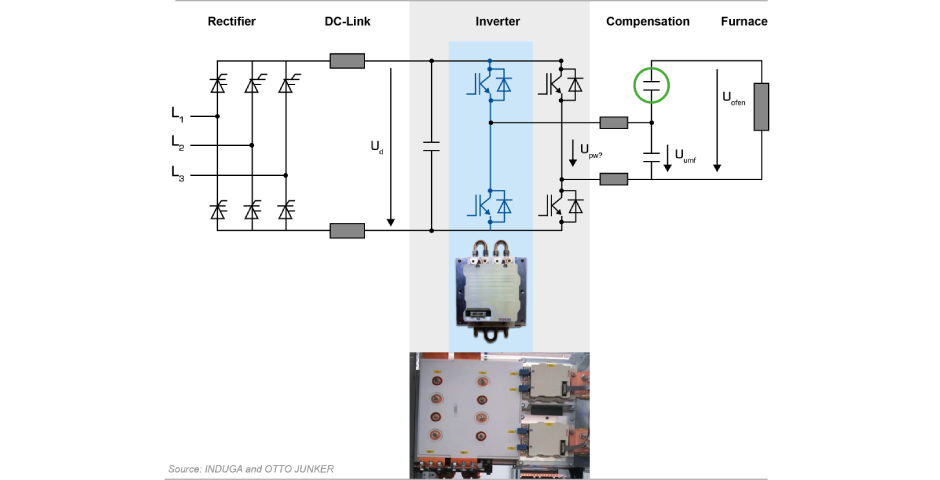
The current d.c. link circuit converters (inverter with thyristors) and voltage d.c. link circuit converters (inverter with IGBT) offered by Otto Junker use parallel compensation. With this arrangement, only the real current is provided by the converter while the reactive current part of the furnace current is provided by the capacitors.

We shall now look at the IGBT frequency converters in detail:

The capacity encircled in green only serves for the capacitive coupling and is only required if the inverter output voltage is insufficient for operating the furnace coil, the coreless induction furnace or the channel induction furnace.

An inverter consists of two inverter half bridges. An IGBT module as used by Otto Junker corresponds to an inverter half bridge and is pre-assembled on a water-cooled cooling plate. That way, the IGBT module can be indirectly water-cooled. This is one of the advantages of the system since it makes a separate water cooling with high demands on the water quality redundant. The IGBT module has an integrated control and monitoring electronics system. 

The load circuit consists of an LC parallel oscillating circuit. For coupling to the inverter, a decoupling reactor is required. In case of connection in parallel of inverters, this decoupling reactor ensures a uniform current distribution between the inverters.

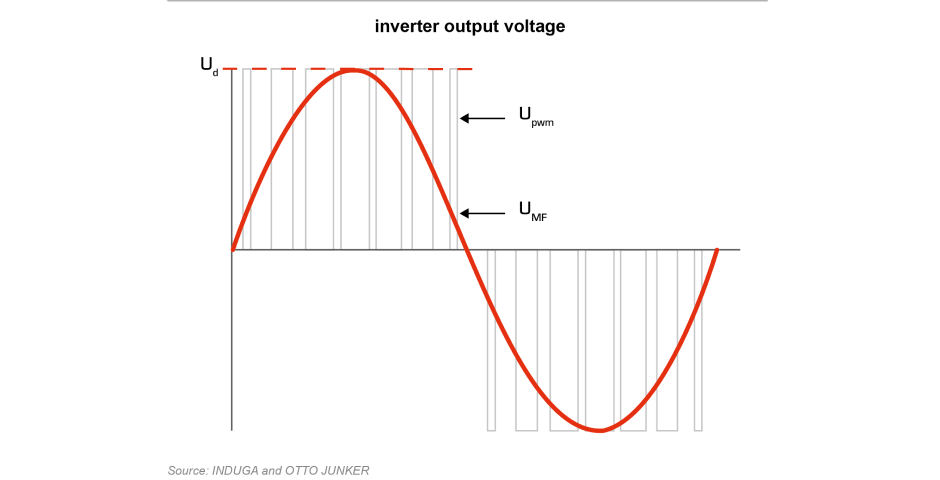
The voltage at the inverter output is generated by means of the modulation method. The inverter is designed as a two-level inverter so that the a.c. voltage at the output can be either positive, negative or zero.

  1. The pulse count of the modulation is always the same.
  2. At lower frequencies, the pulse and the pulse gap get wider as, of course, does the sinus of UMF. This means that the pulse-to-pulse gap ratio remains unchanged!
  3. In order to increase the voltage UMF, the pulses are made wider. This can be carried on up to the max. modulation depth.


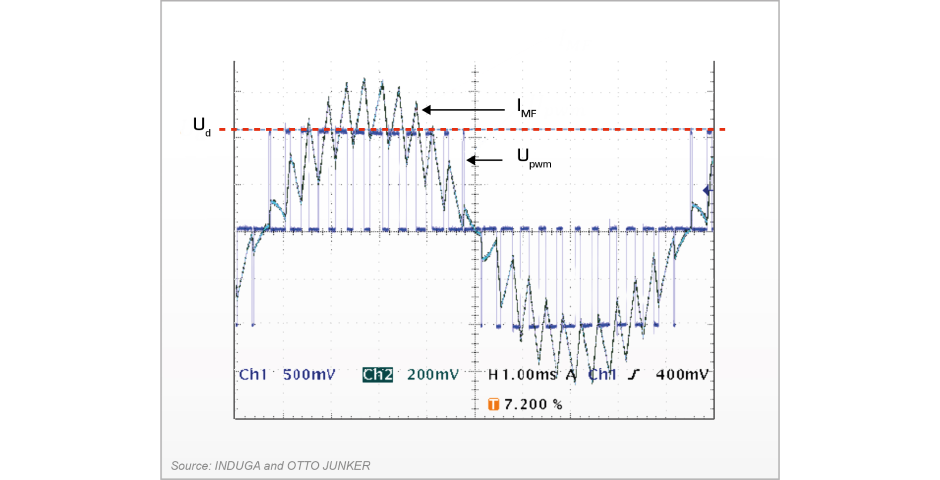
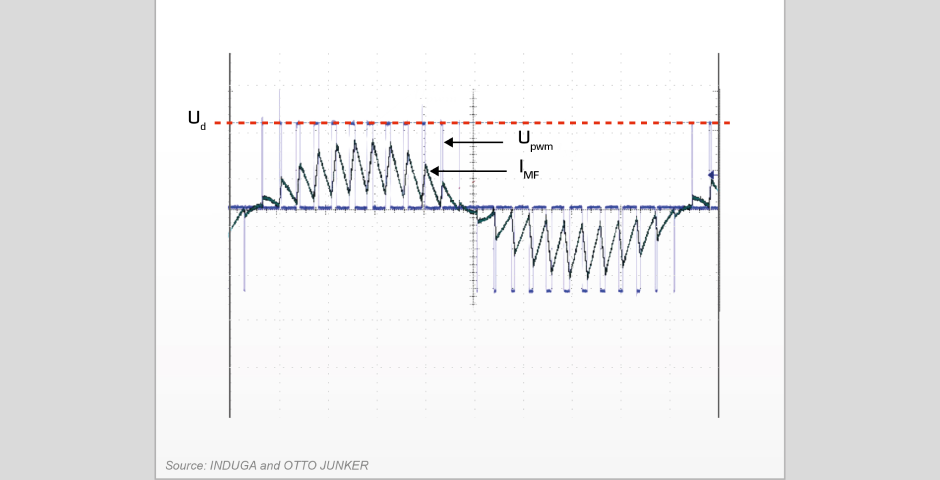
This results in the below current curve: 


  1. UMF is not shown in the diagram but is in phase with IMF
  2. Upwm is shown directly downstream of the IGBT inverter
  3. UMF and IMF are measured downstream of the decoupling reactor by the converter control system
  4. Scanning for measurement of IMF is always in the middle of the pulse of Upwm


  1. Narrower pulses of Upwm lead to a lower voltage UMF and, thus, to a lower current IMF 

Depending on the application of the inductor/the furnace, the IGBT frequency converter has an inverter min. frequency (fmin) and an inverter max. frequency (fmax).

While coreless inductors can have operating frequencies of 250 Hz or more, the two frequencies within which the converter runs during operation on a channel inductor are close to mains frequency. This means that the inductor operation, unlike on conventional switchgear units, is not limited to mains frequency, but to a predetermined frequency range which, thus, represents another control parameter.

Further to that, there is a max. inverter output current (imax) and a max. inverter output voltage (umax) corresponding to UMF max and IMF max up to which the IGBT frequency converter can operate. Once the IGBT frequency converter reaches any of these limits, e.g. due to an excessively changed load, the control range of the IGBT frequency converter is no longer sufficient. You can still continue to operate the frequency converter, but the max. power can no longer be reached. 

This limitation is effected automatically by the converter control system. While the current on conventional switchgear units is a result of other values, with a converter, it is another control value. This offers pronounced advantages when working with channel inductors which we will look at in detail below.

4 OPERATING BEHAVIOUR OF THE CHANNEL INDUCTOR ON THE igbt CONVERTER 

4.1 General

Channel inductors need to be operated at low frequencies, since it is a core type transformer. As explained above, conventional electric switchgear units are used for the operation of channel inductors at mains frequency. Depending on the place of installation, this means either 50 Hz or 60 Hz.  

As the clogging of the channel builds up, the phase currents (I1, I2, I3) on conventional switchgear units rise. Once the phase currents exceed the admissible rated currents at 100 per cent duty factor of the respective multi-tap transformer or when the channel inductor starts pinching so frequently that an acceptable production operation is no longer possible, the channel inductor needs to be replaced in order not to damage the multi-tap transformer and/or to overstress the electrical components and in order to reestablish an acceptable production operation. 

A frequency converter does not have to be operated at the exact rating frequency of 50 Hz. It can work within a frequency range of, say, 40-65 Hz. Thus, it offers a lot more options to achieve an optimum power input, for example for compensating inaccuracies during inductor calculation respectively design, a changed geometry of the refractory lining, erosion or clogging of the channel.

During the service life of a channel inductor, the frequency converter can, up to a certain degree, compensate changes of the channel inductor by itself.

The frequency converter has a min. inverter frequency (fmin) down to which it can operate, a max. inverter output current (imax) and a max. inverter output voltage (umax). 

Erreicht der Frequenzumrichter in der Lebenszeit des Rinneninduktors eine dieser Grenzen, ist der Regelbereich nicht mehr ausreichend und der Rinneninduktor wird die ursprüngliche Wirkleistung nicht mehr erreichen.

4.2 Behaviour of a frequency converter during clogging of an attached channel inductor

As the channel inductor clogs, the displayed frequency on the frequency converter will continue to drop until its min. inverter frequency is reached. If the channel inductor continues to clog, the frequency converter will start generating reactive power and the output current IMF will rise until it reaches its max. inverter output current (imax). From this point onwards, the real power of the channel inductor will drop. By disconnecting partial capacities in the parallel oscillating circuit, the displayed frequency on the converter will rise again, the current IMF will drop and the frequency converter will operate within its limits again. The real power of the inductor is reached again.

This can be carried on until only the basic capacity in the parallel oscillating circuit is left, without which an operation is no longer possible or until the channel of the channel inductor is clogged to the point where the channel inductor pinches so frequently that an acceptable production operation is no longer possible.

This also means that the user of a frequency converter can respond to a completely changed channel geometry and, thus, a channel inductor can be operated a lot longer.

4.2.1 Frequency converter - partial function: “Automatic pinching mode”

The s.p. power set on the frequency converter by the operator is adjusted by the control program on the integrated micro controller (ZEUS). 

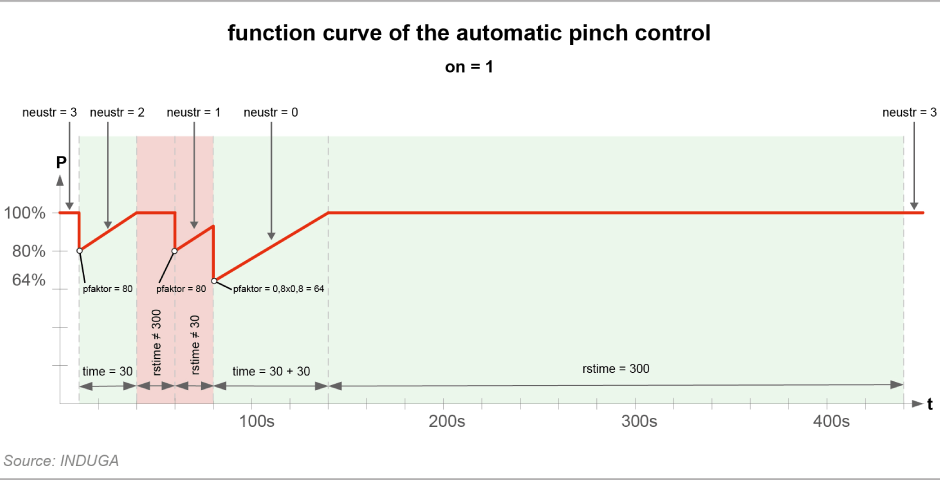
If, due to excessive electromagnetic forces in the metal channel (as described above), the so-called pinching occurs, this will be detected by the converter as exceedingly rapid load changes.  

The IGBT converters used by Induga shall then switch to the “automatic pinching mode”. This means that the converter control system will automatically try to approach the highest possible power which, however, does not quite cause pinching again.

Example:

4.3 Explanation of further operating procedures as compared to conventional switchgear units

4.3.1 Starting of furnace

If the channel inductor is equipped with a solid channel (as opposed to a wooden former or a pre-sintered channel), it will be started electrically according to a sintering curve. This needs to be done at a low power tap because during the transition from solid to liquid condition, excessive power and/or excessive power fluctuations will cause a gap in the inductor channel. As a consequence, the channel inductor would have to be completely relined and prepared. Here, the IGBT converter offers the advantage that it can be operated infinitely and continuously at min. power. The conventional power supply can only follow the sintering curve a lot less accurately by alternately switching on and off of smallest power tap.

4.3.2 Melting and holding

While with conventional switchgear units, controlling of the furnace condition is effected via switching of the taps and/or capacitors, with the converter this is done fully automatically. During the melting process, typically there are permanent condition changes due to, say, temperature, furnace filling level or charging. In spite of this, the converter at the mains input, due to the automatic infinite control, achieves a permanent cos (phi) of 0.98-1. With a conventional switchgear unit, this value can be considerably worse depending on switching condition and controls.

Looking at the switching operations themselves, with conventional switchgear units these are always limited due to wear so that the respective components have to be replaced regularly. With the converter, the switching operation is carried out mechanically, i.e. it is maintenance-free. 

The automatic pinching mode described under 4.2.1 also is of great benefit for the melting process. Due to the varied filling levels of the furnace, the inductor can also tend to pinch if the supplied power is too high. As described above, the converter will adjust the power automatically. With the conventional units, this inexperience with regard to pinch behavior can lead to overloading of the switchgear or a gap in the inductor channel. 

During holding, the furnace conditions are less variable. Controlling is usually via temperature so that the advantages of the converter are less pronounced. 

5 SUMMARY OF ADVANTAGES (+) AND DISADVANTAGES (-)

5.1 Conventional mains-frequency switchgear unit:

+ simple switching technology

+ Even with a defective control system, the furnace can still be supplied with power.

+ / - at the entry to the mains-frequency switchgear unit cos(phi) <=0.95

- no infinite power control

- For power changes, the furnace has to be briefly switched off.

- Furnace conditions have to be adjusted by constant switching of contactors.

- Contactors were out and, thus, require more maintenance even though the electotechnology itself is simpler.

5.2 IGBT converter:

+ infinite control

+ at the converter entry cos (phi) = 0,99 to 1 across the entire power range

+ Furnace conditions are automatically adjusted by the converter

+ No switching off required for increasing the power during operation

+ almost maintenance-free

+ Starting of the inductor with solid channel a lot easier

- Water cooling required

- In case of converter failure, an emergency power supply is more complex

Firmeninfo

INDUGA Industrieöfen und GießereiAnlagen GmbH & Co. KG

Jägerhausstr. 2
52152 Simmerath-Lammersdorf

Telefon: +49 2473 601710

[79]
Socials