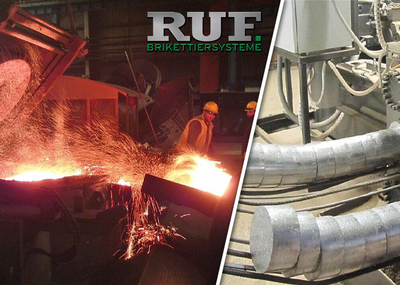
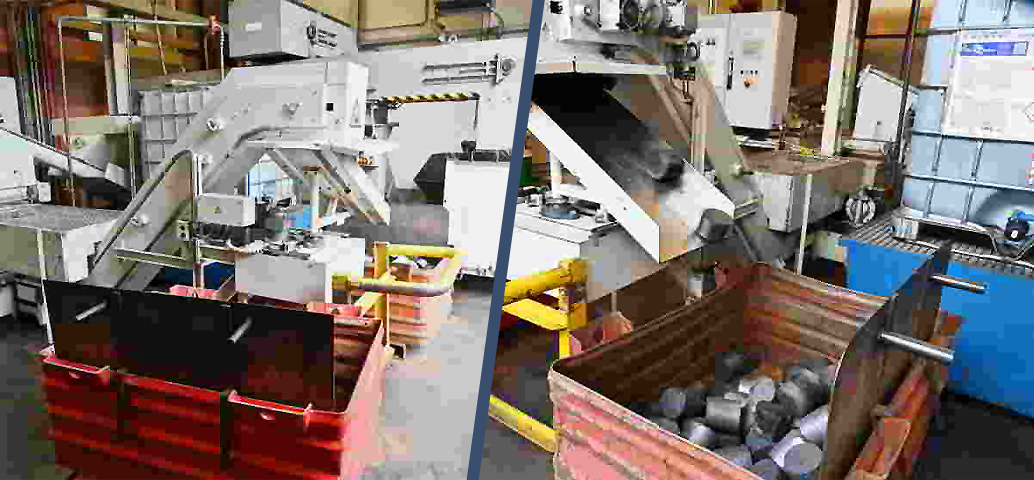
Everllence compacts the cast iron chips generated during production into dense briquettes and remelts them in its own foundry. In doing so, the Augsburg-based company closes its internal material loop and reduces costs. Three briquetting systems from RUF are currently in operation, processing well over 1,000 tons of chips per year. As part of a production expansion, one of the briquetting presses is now being upgraded.
The company’s headquarters and main plant are located in Augsburg. More than 4,000 employees manufacture large four-stroke engines for marine propulsion and power generation, as well as turbochargers. The heaviest product built here is an 18-cylinder turbocharged engine delivering 21,600 kilowatts and weighing 270 tons.
Production begins at the iron foundry, which has been in operation since 1844. Around 300 employees produce engine components ranging from 300 kilograms to 120 tons, made from gray cast iron (GJL, flake graphite iron) and ductile cast iron (GJS, nodular graphite iron). The foundry also supplies other Everllence locations in Saint-Nazaire, France, and Aurangabad, India, as well as external customers.
Sustainability plays a key role at Everllence. Up to 90 percent of the raw materials used are secondary materials, and the foundry is powered largely by green electricity. In addition, the company closes the material loop directly on site by remelting machining chips. RUF briquetting presses are central to this process.
High handling effort with loose and wet chips
The closed-loop recycling of production residues has a long tradition at Everllence. However, before the introduction of briquetting technology, it caused considerable difficulties.
“Handling wet chips was always a major problem for us,” explains Erwin Schuster, Head of Crankcase Production. Loose chips contaminated with cooling lubricants created significant soiling during transport from machining to the foundry. At the same time, the foundry requires material that is as dry as possible to ensure safe and efficient melting.
25 years of reliable operation
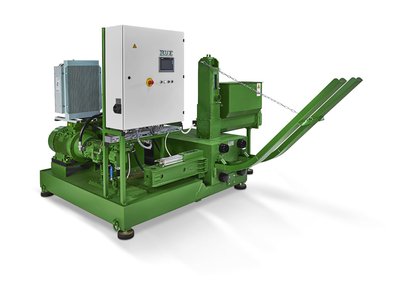
The solution came in 1999 when RUF supplied the first briquetting press. The RB 15/3000/80 model is still operating reliably in cylinder head production today, producing around 100 tons of briquettes per month.
The designation stands for 15 kW electrical power, a specific pressing pressure of up to 3,000 kg/cm², and a briquette diameter of 80 millimeters.
Under high pressure, the machines automatically compress metal chips into compact briquettes that are easy to handle and require far less storage volume than loose chips. At the same time, the densely compacted briquettes can be remelted just as easily as solid scrap.
Briquettes can be remelted without difficulty
A crucial advantage is that almost all residual cooling lubricants are squeezed out during pressing. This makes the briquettes largely dry, while the extracted coolant can often be collected and reused.
For the foundry, briquetting and the closed material loop offer several benefits. Tobias Rist, Operations Engineer in the melting shop, explains:
“We know the exact composition of the briquettes because they originate from our own cast iron. That allows us to use them very effectively for charge optimization.
Because the briquettes contain very little residual moisture, significantly less smoke is generated during melting compared to wet chips. Additional exhaust treatment measures are therefore unnecessary. Residual moisture typically ranges between one and three percent and decreases further after a few days of storage.
Use in both line-frequency and medium-frequency furnaces
While loose chips often cause melting problems, briquettes can be used on an equal footing with other scrap materials.
At Everllence, they are charged into both line-frequency and medium-frequency furnaces. In line-frequency furnaces, the briquettes are not added directly to the molten iron. Instead, solid scrap is charged first, and the briquettes are placed on top. The heat from below dries them completely before they melt.
This results in high metal yield with no negative effects on melting time, emissions, refractory lining, or energy consumption — while significantly reducing costs.
Closed-loop system reduces costs
Besides environmental benefits, the closed material loop also provides clear economic advantages. Using briquettes is considerably cheaper than purchasing external scrap. Experience from various RUF customers indicates savings of around €120 per tonne.
Encouraged by the positive results, Everllence installed two additional RUF systems in 2005 and 2008. One processes around 20 tonnes of chips per month, while the other — serving large gantry milling machines — handles roughly 40 tonnes. The briquettes measure 100 mm in diameter, about 80 mm in length, and weigh approximately 3.5 kilograms.
Fully automatic operation – minimal maintenance
The presses operate fully automatically in 24/7 mode, starting and stopping independently depending on material availability. Only the collection containers for finished briquettes need to be replaced when full.
Maintenance requirements are minimal. “The systems are extremely reliable. Only occasional seal replacements or small wear parts are necessary,” reports machine and plant planner Ralph Fritz.
Challenge: strongly fluctuating chip volumes
One particular challenge is the highly fluctuating volume of chips generated during machining of the large crankcases. For example, machining an 88-tonne casting can produce up to 14 tonnes of chips, which often arrive at the press in large batches.
To manage this, a 1.5-cubic-meter buffer hopper was installed and the system designed for peak capacities of 800 kilograms per hour.
Existing press upgraded for higher volumes
With the addition of a third gantry milling machine, monthly chip volumes will increase to around 60 tonnes. Instead of purchasing a new system, Everllence chose — following RUF’s recommendation — to upgrade the existing press.
After comprehensive service and technical modifications, it is expected to operate reliably for many more years. Planned upgrades include a hopper one-third larger and new conveying equipment.
The modernization will be completed within a few days and without significant disruption to production.